The Sidecar Pattern: Cross-Cutting Concerns Without Code Changes
Series: System Design · Architecture Patterns — Pillar 7 of 8
Systems Design
| # | Post | What it covers |
|---|---|---|
| 00 | Architecture Patterns: How Systems Are Structured | Twenty patterns covering monoliths, microservices, events, resilience, deployment, and data processing. How to structure systems that survive growth. |
| 01 | Monolithic Architecture: The Default That Gets Abandoned Too Early | Monoliths are fast to build and easy to operate. Learn when they're the right choice, when they break down, and how to know the difference. |
| 02 | Microservices: The Architecture You Earn, Not Choose | Microservices enable independent scaling and team autonomy — but at significant cost. Learn what you actually get, what you pay, and when it's worth it. |
| 03 | Serverless: Pay for What You Use, Not What You Provision | Serverless scales to zero and charges per invocation. Learn where it shines, where it fails, and how to design around cold starts and vendor lock-in. |
| 04 | Event-Driven Architecture: Decoupling Through Events | Event-driven systems communicate via events rather than direct calls. Learn how producers, consumers, and event brokers work — and the consistency tradeoffs involved. |
| 05 | Message Queues: Decoupling Produce from Consume | Message queues decouple producers and consumers, enable load levelling, and provide durability. Learn how they work and when to use Kafka vs SQS vs RabbitMQ. |
| 06 | Pub/Sub: Broadcasting Events to Multiple Consumers | Pub/sub decouples publishers from subscribers through topics. Learn how it differs from message queues and when to use Kafka, SNS, or Google Pub/Sub. |
| 07 | CQRS: When Reads and Writes Need Different Models | CQRS separates writes from reads so each can be optimised independently. Learn how it works, when it's worth the complexity, and when it isn't. |
| 08 | Event Sourcing: The Ledger, Not the Balance | Event sourcing stores state as a sequence of events. Learn how it works, what you get (audit log, time travel), and what it costs (complexity, schema evolution). |
| 09 | The Saga Pattern: Distributed Transactions Without Locks | The Saga pattern manages distributed transactions across services using compensating transactions. Learn choreography vs orchestration and when to use each. |
| 10 | The Outbox Pattern: Atomic Writes and Event Publishing | The Outbox pattern solves the dual-write problem — publishing an event and writing to a database atomically. Learn how it works using CDC or polling. |
| 11 | The Circuit Breaker: Stopping Cascading Failures | Circuit breakers prevent cascading failures by fast-failing calls to unhealthy dependencies. Learn the three states, how to configure them, and where to apply them. |
| 12 | The Bulkhead Pattern: Containing Failures Through Resource Isolation | Bulkheads isolate thread pools and connections per dependency so one failure can't exhaust resources needed by others. Learn how to apply them in practice. |
| 13 | The Sidecar Pattern: Cross-Cutting Concerns Without Code Changes ← you are here | The sidecar pattern deploys a helper process alongside each service for logging, metrics, TLS, and service discovery — without modifying the service itself. |
| 14 | Service Mesh: A Programmable Network for Microservices | A service mesh handles service-to-service traffic, mTLS, circuit breaking, and observability via a fleet of sidecar proxies. Learn how it works and when to use it. |
| 15 | Service Discovery: Finding Services in a Dynamic Environment | Service discovery lets services find each other in dynamic environments. Learn client-side vs server-side discovery, health checks, and DNS vs registry approaches. |
| 16 | The Strangler Fig: Replacing a Legacy System Without Burning It Down | The Strangler Fig replaces a legacy system incrementally by routing specific functionality to new implementations while the old system keeps running. |
| 17 | Backend for Frontend: One API Per Client Type | BFF creates dedicated API backends per client type. Learn why one general API struggles to serve mobile and web well, and how BFF solves it. |
| 18 | ETL Pipelines: Moving Data from Operations to Analytics | ETL moves data from operational systems into analytical stores. Learn how pipelines work, what ELT is, and how to design reliable data movement at scale. |
| 19 | Batch vs Stream Processing: How Fresh Do Your Answers Need to Be? | Batch processes accumulate data then processes in bulk; streaming processes each event as it arrives. Learn the tradeoffs and when each is right. |
| 20 | MapReduce: Processing Petabytes in Parallel | MapReduce processes massive datasets in parallel by splitting work into map and reduce phases. Learn how it works and why Spark has largely replaced it. |
| 21 | Architecture Patterns: Wrap-Up | A recap of all 20 architecture patterns across decomposition, async communication, data patterns, resilience, and data processing. How they connect. |
The Sidecar Pattern: Cross-Cutting Concerns Without Code Changes
The problem
Your URL shortener has ten microservices. Every service needs:
- Logging in a consistent format, shipped to your log aggregator
- Metrics exposed in Prometheus format
- mTLS for encrypted, authenticated service-to-service communication
- Service discovery to find other services' addresses
- Circuit breaking for outbound calls
- Distributed tracing with trace propagation
Without the sidecar pattern, each team implements all of this in their service's language. The Go team writes it in Go. The Python team writes it in Python. The Node.js team writes it in Node. They use different libraries, implement them differently, and you end up with inconsistent behaviour across services.
What you want: one implementation of these cross-cutting concerns, deployed consistently alongside every service, regardless of language.
The core idea
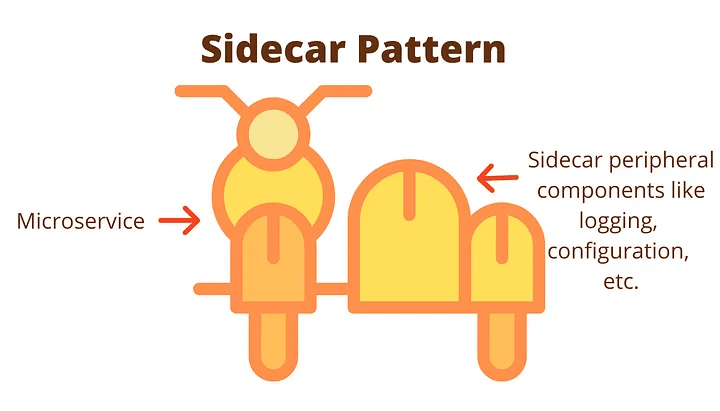
The sidecar pattern deploys a helper process (the "sidecar") in the same network namespace as the main service container. The sidecar handles cross-cutting concerns — observability, security, networking, service discovery — on behalf of the main service. The main service focuses entirely on business logic; infrastructure concerns are the sidecar's job.
The analogy: a motorcycle sidecar
A motorcycle's sidecar is a separate compartment attached to the bike. It travels with the bike and shares its destination, but it doesn't drive — it carries cargo or passengers that the bike couldn't handle alone. The sidecar doesn't change how the motorcycle works; it augments what it can carry.
The software sidecar works the same way: it travels alongside the main service (same pod, same node), augments its capabilities (metrics, logging, security), and doesn't change how the main service works.
How it works
Deployment model (Kubernetes)
In Kubernetes, the sidecar runs as an additional container in the same Pod as the main service container. Pod containers share:
- The same network namespace (localhost, same IP)
- The same storage volumes (mounted filesystems)
- The same lifecycle (start and stop together)
apiVersion: v1
kind: Pod
spec:
  containers:
  - name: link-service          # main service
    image: link-service:v2.3
    ports:
    - containerPort: 8080

  - name: envoy-proxy           # sidecar
    image: envoy:v1.28
    ports:
    - containerPort: 9901       # admin port
    # intercepts all inbound/outbound traffic on the pod
What sidecars handle
Traffic proxy (Envoy, Nginx): The sidecar intercepts all inbound and outbound network traffic via iptables rules. The main service's code makes a normal HTTP call to "analytics-service". The sidecar intercepts this call, applies circuit breaking, retries, load balancing, and mTLS — transparently.
The main service never knows the sidecar exists; it thinks it's talking directly to analytics-service.
Observability:
- Log forwarding: the sidecar tails the main service's log files and ships them to a central aggregator (Datadog, Loki, Elasticsearch) in a consistent format
- Metrics: the sidecar exposes metrics about incoming and outgoing requests (request rate, error rate, latency) that were intercepted through the proxy
- Tracing: the sidecar automatically propagates trace headers on outbound calls and generates spans for inbound requests
Security (mTLS): The sidecar holds TLS certificates (rotated automatically via cert-manager or a service mesh control plane). All service-to-service communication is encrypted and mutually authenticated — the main service code uses plain HTTP; the sidecar encrypts it.
Configuration: The sidecar can pull configuration from a central store and inject it as environment variables or files, keeping configuration management out of the main service.
The sidecar as the foundation of a service mesh
When every service has the same sidecar proxy deployed, you have a service mesh's data plane. The sidecars handle:
- Routing (send 10% of traffic to the canary version)
- Circuit breaking (configured centrally, not per service)
- mTLS (automatic certificate rotation)
- Distributed tracing (no application code required)
All controlled by a central control plane (Istio, Linkerd) that pushes configuration to each sidecar.
This is the architecture covered in depth in the next post.
Tradeoffs
Language agnosticism vs resource overhead. The sidecar handles cross-cutting concerns in one place, regardless of the main service's language. The cost: every pod runs two containers. A cluster with 100 pods has 100 Envoy sidecar instances consuming CPU and memory. At scale, this overhead is real — Envoy sidecars typically consume 50–200MB of RAM per instance and add 1–3ms of latency per hop.
Operational uniformity vs flexibility. All services behave consistently — logging, metrics, and circuit breaking are configured centrally. The downside: you lose per-service flexibility. A service that needs a custom circuit breaking configuration must be accommodated through sidecar configuration, not application code.
Deployment coupling. The sidecar lifecycle is tied to the main service. An Envoy upgrade requires re-deploying every pod. Some service meshes support zero-downtime sidecar upgrades; others require careful rolling restarts.
The one thing to remember
The sidecar pattern separates cross-cutting concerns (observability, security, traffic management) from business logic by running them as a co-located helper process. The main service focuses on its domain; the sidecar handles the plumbing. This is the foundation of service mesh architectures, where a fleet of identical sidecar proxies forms a programmable network layer across all services — without requiring any service to implement networking logic.
← Previous: Bulkhead — isolating resource pools per dependency so one slow service can't starve another.
→ Next: Service Mesh — when every service has a sidecar, you have a service mesh; here's how the control plane manages that fleet.


